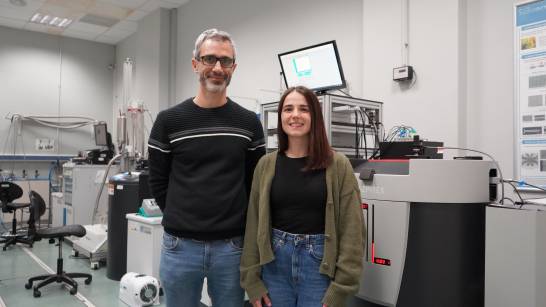
A research team at the Basque nanoscience centre CIC nanoGUNE has, for the first time, experimentally drawn a spin current out of an altermagnet — a current that carries the material's internal magnetic information — according to Sinc. The work was carried out by the centre's Nanodevices group with the Mesoscopic Physics Group at the Centre for Materials Physics (CFM) and partners in the Czech Republic, Germany and France, and is published in Nature. The result confirms a prediction made a few years ago by research groups in the Czech Republic and Germany.
Why it matters
Conventional magnets, or ferromagnets, store data through a net magnetisation — the summed magnetic moments of their atoms — and that is the principle behind hard drives, servers and magnetic-stripe cards. Altermagnets, like antiferromagnets, have no net magnetisation at all: their magnetic moments cancel out. That makes their magnetic order invisible from the outside, and it also means the usual magnetic readout has nothing to latch onto. The nanoGUNE experiment offers a way in, and it points toward memory that could be denser, quicker and harder to disturb than today's magnetic storage.
Reading order that leaves no external field
Antiferromagnets have been known for roughly a century, but the compensated class now called altermagnets was identified only recently. Their magnetic order still has two possible states, yet because no external field arises from it, the information sits hidden inside the material.
What distinguishes altermagnets is that this internal order shapes how electrons behave. Fèlix Casanova, who leads the Nanodevices group at nanoGUNE, explained that this interaction makes it possible to convert the magnetic information into an electrical signal, giving a route to reach it.
To show this, the team built a nanodevice that pulls the magnetic information out of the altermagnet and carries it to a detector. Jone Mencos, a researcher in the same group and first author of the paper, said the altermagnet and the detector sit only about 300 nanometres apart — roughly one hundredth of the width of a human hair. When an electric current is passed through the altermagnet, its internal magnetic order acts on the electrons and produces a spin current. That current travels along a metallic channel to the detector, where it registers as an electrical signal.
The team then reversed the material's magnetic order using strong magnetic fields available in its laboratory, and found that the detected signal flipped direction as well. According to Mencos, that correspondence ties the electrical signal to the altermagnet's internal magnetic state and rules out other effects in the device as its source. The CFM group's theoretical model of electron transport backs the experimental result.
What the material class could offer memory
Because altermagnets carry no net magnetisation, their magnetic order can in principle be switched faster than a ferromagnet's. They are also less affected by outside magnetic fields of the kind that can wipe conventional magnetic memories, and they produce less interference between neighbouring devices — a combination the researchers say could allow more data to be packed into less space.
Casanova framed the remaining work plainly: the next challenge is to switch the magnetic order using low-power electrical pulses and to get these devices operating at room temperature. Until those two problems are solved, the result stands as a laboratory demonstration of readout rather than a manufacturable memory technology.
Watch for follow-up work from the same collaboration on electrical switching and room-temperature operation, the two conditions that would move altermagnets from a physics result toward practical devices.